

Fulfillment Integrations for Ecommerce, Marketplace, and Retail Channels
ASTORAGEHUB connects with e-commerce platforms, marketplaces, and shipping tools. Orders and inventory data from connected sales channels flow into one fulfillment platform, where your team can see inventory, shipments, activity, and billing in one place.
Your sales channels stay exactly where they are. The warehouse operations behind them become automated, structured, and visible in real time.
Platforms Our Clients Sell On
These are the channels most commonly used by ASTORAGEHUB clients today. Each integration connects your sales channel with ASTORAGEHUB Fulfillment, helping automate fulfillment workflows and keep inventory and operations visible across connected platforms.
Amazon
Marketplace · FBA & FBM- FBA inbound replenishment to Amazon fulfillment centers
- FBM orders fulfilled from ASTORAGEHUB inventory
- Inventory visibility across fulfillment workflows
- Fulfillment activity managed in ASTORAGEHUB
Walmart Marketplace
Marketplace · WFS & Seller Fulfillment- WFS inbound replenishment to Walmart fulfillment centers
- Seller-fulfilled orders processed from ASTORAGEHUB inventory
- SFS and Ship with Walmart (SWW) shipping workflows supported
- Inventory and fulfillment activity visible in ASTORAGEHUB
Shopify
Ecommerce platform · DTC- Shopify orders synced with ASTORAGEHUB Fulfillment
- Inventory visibility and SKU mapping across the fulfillment workflow
- Orders fulfilled from ASTORAGEHUB inventory
- Fulfillment status and tracking returned to Shopify
TikTok Shop
Social commerce · FBT & Seller Fulfillment- FBT workflows supported
- Seller-fulfilled orders processed from ASTORAGEHUB inventory
- TikTok Shipping and Seller Shipping supported
- Inventory, fulfillment status, and tracking visible across the workflow
What Happens After the Order Comes In
An integration that only sends orders to the warehouse solves only half the problem. At ASTORAGEHUB, the same connection also drives receiving, storage, picking, shipping, and billing.
Sales channels
The platform
Orders, SKUs, and inventory data from your sales channels flow directly into ASTORAGEHUB Fulfillment. Inventory, replenishments, orders, reporting, and billing are managed in one dashboard.
Warehouse operations
Every step above is recorded in the platform as it happens. When you open an order, SKU, or invoice line, you see the actual warehouse activity behind it.
What You See Once the Integration Is Live
ASTORAGEHUB Fulfillment gives you a real-time view of your inventory and fulfillment activity. Below are the views your team can use daily to track inventory, orders, replenishments, and warehouse activity as it happens.
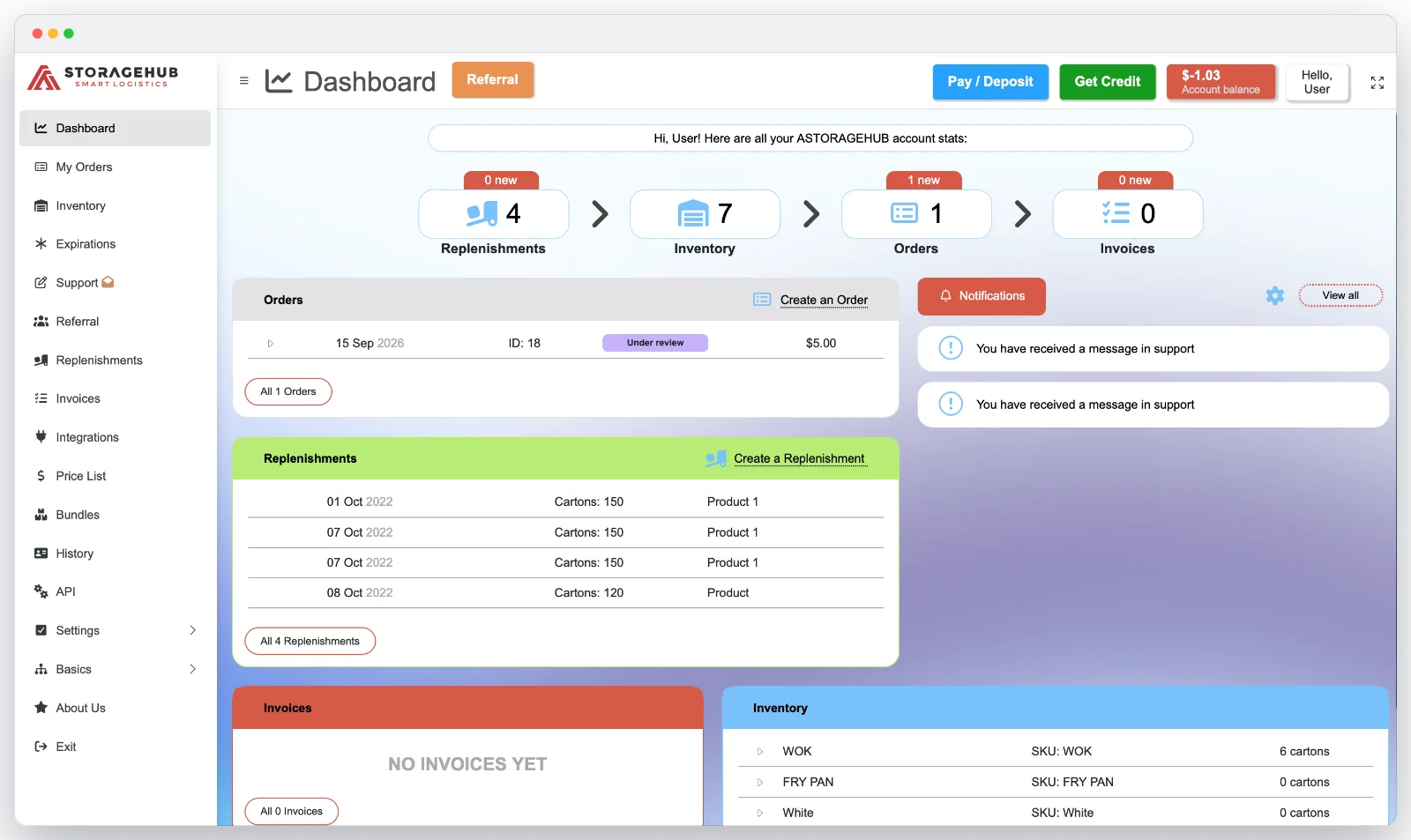
- 1Inventory at a glanceCurrent warehouse inventory overview.
- 2Replenishments and order activityIncoming stock and current fulfillment activity.
- 3Orders overviewOrders and fulfillment status in one place.
- 4Invoices and account activityBilling and account information available in the same platform.
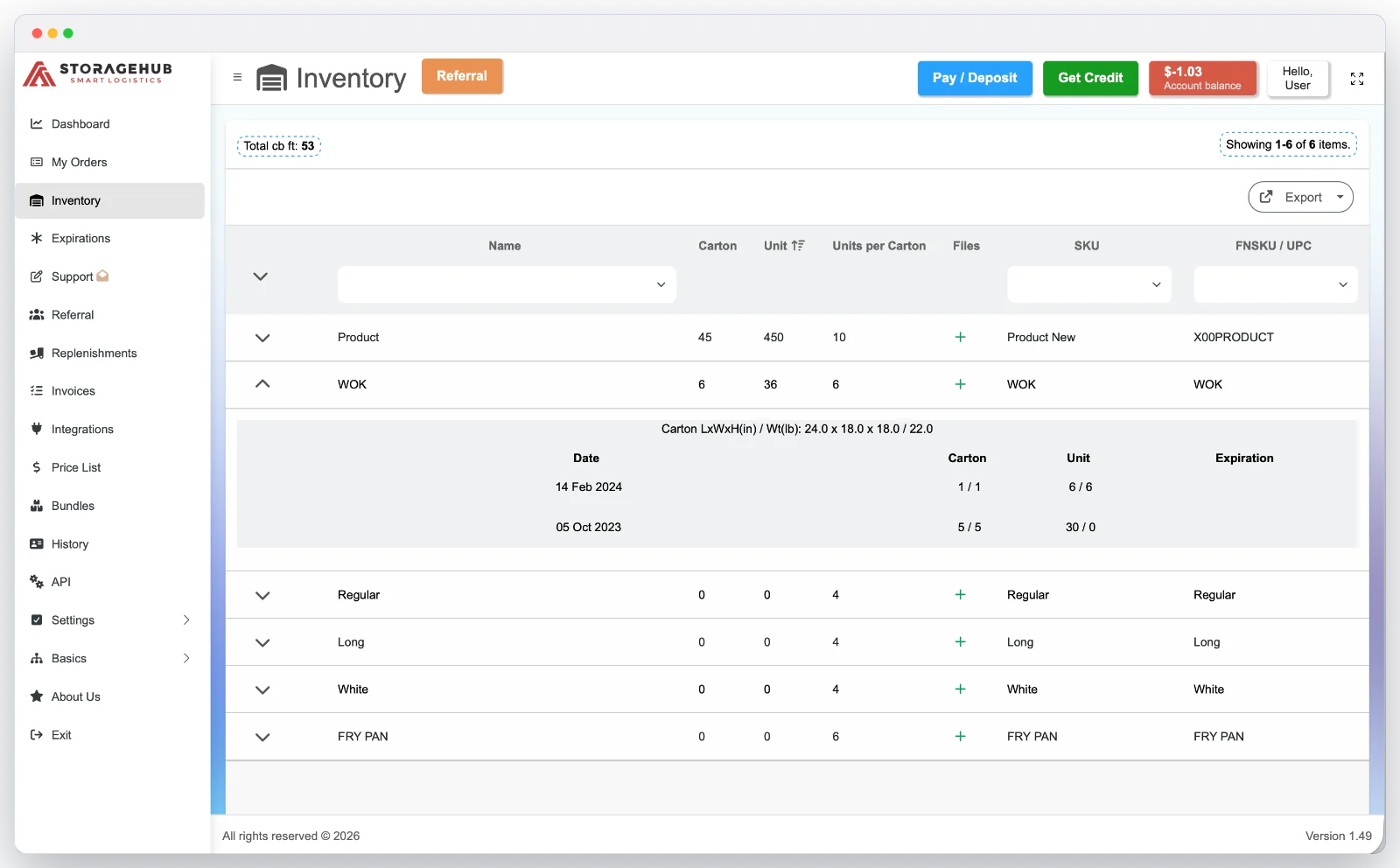
- 1Stock by SKUCartons and units stored for each SKU.
- 2Cartons and unitsInventory counted the way it is physically stored.
- 3Inventory by received dateStock grouped by received batch and date.
- 4Storage volumeTotal warehouse space currently occupied by inventory.
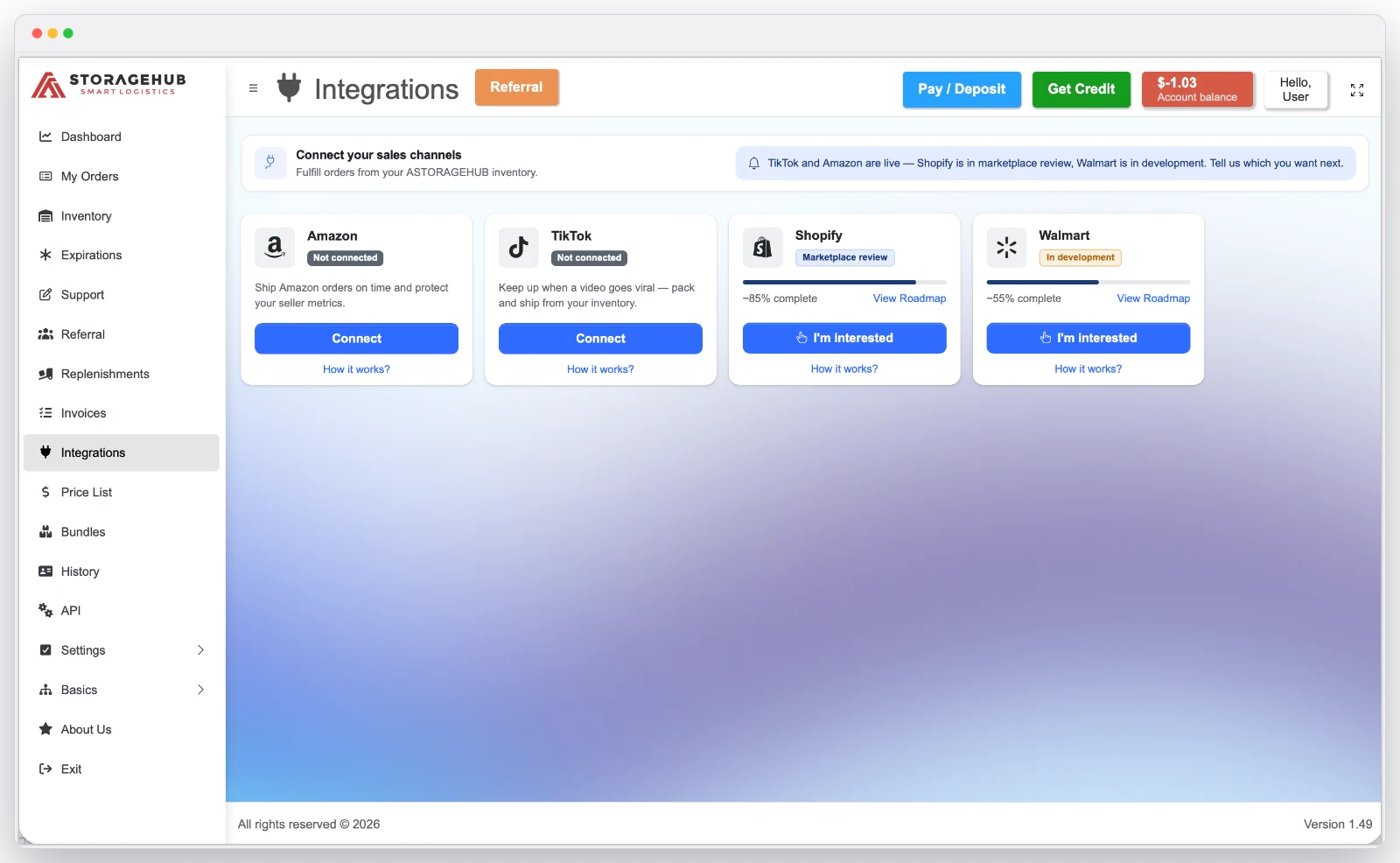
- 1Set up integrations from your accountConnect supported sales channels directly from the ASTORAGEHUB dashboard.
- 2Manage your connected channels in one placeAccess and control marketplace integrations without leaving the platform.
Better Visibility, Better Control, Lower Logistics Costs
Most logistics overspending is not caused by a bad rate. It is caused by inventory decisions made without current data: stock that has not moved in months, inventory counts that no longer match reality, or storage usage that keeps growing without a clear reason. When the data is visible, problems are caught earlier and cost less to fix.
See real inventory, not last week's export
On-hand, available, and allocated quantities updated as warehouse activity happens.
Know how much space your inventory takes
Storage usage in the same units your invoice is calculated from.
Track aging inventory before it turns into dead stock
Identify slow-moving SKUs while there is still time to bundle, discount, or move them.
Understand why storage costs went up
See how volume, aging inventory, and inbound activity affect storage costs.
Find discrepancies faster
Compare expected quantities with actual received counts at intake, not months later.
See Exactly What You Are Paying For
Every charge is tied to a recorded warehouse activity you can review.
The Costs You Cannot See Are Still on Your Invoice
These are the questions your inventory data should answer. The numbers are simple, but small gaps can stay invisible until you see what they actually cost.
You may be paying to store air.
Pallets of actual goods5
Paid for empty space50%
Inventory that could be consolidated may still occupy full pallet positions. Storage usage data makes that visible before the next billing cycle.
A 2% inventory discrepancy sounds small.
Discrepancy2%
Unaccounted value$3,000
Counts recorded during receiving, picking, and shipping help identify discrepancies while they can still be traced to a specific shipment.
30 missing units do not sound like much.
Unit cost$80
Value at risk$2,400
Those 30 units can also mean lost sales, canceled orders, and inaccurate inventory across your sales channels.
Your storage bill went up. Do you know why?
Inbound volume increased
Slow SKUs stopped moving
The answer is visible in the dashboard.
Inventory levels, storage usage, and inbound activity are tracked in the same system, so changes in storage costs can be explained instead of estimated.
How long has this inventory been sitting here?
Aging data helps you decide what to do next: promote it, bundle it, move it to another channel, or clear it out.
Where this leads
Faster action→
Lower logistics costs
None of this requires a new warehouse or a new rate card. It requires seeing what is happening early enough to act on it.
The Full Integration Catalog
ASTORAGEHUB connects directly with the sales channels and shipping tools below. If your system does not connect through a standard integration, it may still be connected through the ASTORAGEHUB API.
Ecommerce Platforms & Marketplaces
Shipping & Carrier Tools
Custom API & Integrations
If It Is Not on the List, It Can Still Be Connected
The ASTORAGEHUB API is open to clients. Teams using an in-house ERP, a private ordering portal, or another custom system can connect directly and keep their existing workflow.
- 01Pull inventory data into your own dashboards, forecasts, or replenishment logic.
- 02Push orders into the fulfillment workflow from any system that can send a request.
- 03Retrieve shipment status and carrier tracking updates.
- 04Access billing and activity records for finance reporting and reconciliation.
- 05Automate recurring data exchanges on a schedule instead of exporting spreadsheets.
- 06Connect systems without a standard connector through a custom integration built for your setup.
Tell Us What You Are Running Today
Tell us which sales channels, ERP or order management systems you use, and how your orders and inventory are managed today. We'll map out how they can connect to ASTORAGEHUB and what the setup involves.