

Two warehouses quote you for the same inventory. One charges per pallet, the other per cubic foot, and the numbers look impossible to compare.
They’re not. Run both quotes through a simple pallet cubic feet calculator, like the break-even formula below, and the answer usually comes down to one question: how full are your pallets? A full, tall pallet is cheaper on a per-pallet rate. A half-empty one is usually cheaper by the cubic foot.
This guide explains how each model works, puts the math side by side, and shows you the break-even point where the answer flips. You’ll also get a checklist to see which model fits your products.
Key Takeaways
- Pallet pricing is usually cheaper for full, standard pallets of bulk goods.
- Cubic feet pricing is usually cheaper for small items, partial pallets and many SKUs.
- At average US rates, the break-even is a pallet loaded about 39 inches high.
Table of contents
How warehouse storage pricing works
Most storage and warehousing providers charge for space in one of four ways:
- Per pallet: a flat monthly fee for each pallet position, however full the pallet is.
- Per cubic foot: a monthly rate for the volume your goods actually take up.
- Per bin or shelf: a fee for each bin or shelf location, common for small, loose items.
- Per square foot: a rate for floor space, usually for dedicated areas or long-term contracts.
Why it matters. The same inventory can cost very different amounts depending on the model, because each one charges for a different kind of space. A half-empty pallet costs the same as a full one under pallet pricing, but about half as much as a full one under cubic pricing.
Storage vs handling fees. Storage is the monthly rent for space. Receiving, picking and packing are charged separately, so when you compare 3PL storage fees, compare the handling fees too. A cheap storage rate can hide expensive handling.
The rest of this guide focuses on cubic vs pallet storage, the two models most brands choose between.
What is cubic feet pricing?
With cubic feet pricing, you pay for the volume your goods occupy, not for the pallet or shelf they sit on.
How cubic feet are measured and billed
Measuring. The warehouse multiplies the length × width × height of your stored cartons or pallet loads, in feet. If you measure in inches, multiply the three sides and divide by 1,728. Most warehouses record carton sizes when stock arrives, so sending accurate dimensions in advance keeps your first bill close to your estimate.
Billing. With cubic storage, many warehouses measure the space you use every day, average it over the month, and multiply by the rate per cubic foot. For example, an average of 500 cu ft × $0.46 = $230 a month, using the typical US market rate. As stock sells, the daily volume drops, and the bill falls with it.
Pros and cons of cubic feet pricing
| Pros | Cons |
|---|---|
| You pay only for the space your goods use | Needs accurate product and carton dimensions |
| Storage costs drop as stock sells | Tall or bulky loads cost more |
| Fits partial pallets and loose cartons | The bill changes from month to month |
Cubic feet vs pallet pricing at a glance
| Criteria | Cubic feet pricing | Pallet pricing |
|---|---|---|
| How it’s billed | Per cubic foot of space used, per month | Per pallet position, per month |
| Typical US rate | $0.35–$0.60 per cu ft (average about $0.46) | $12–$22 per pallet for dry storage (average about $20) |
| You pay for | The actual volume of your goods | The whole pallet position, full or not |
| Best for | Small, mixed or slow-moving SKUs, partial pallets | Full, standardized pallets of bulk goods |
| Watch out for | Accurate dimensions; tall loads cost more | Paying for empty space on half-full pallets |
What is pallet pricing?
With pallet pricing, you rent a pallet position, the space for one pallet on the floor or in a rack, and pay a flat monthly fee for it.
How pallet positions are billed
Standard pallet. In the US, a standard pallet has a 48 × 40 in footprint, which covers 13.33 sq ft. Height limits vary by warehouse, often around 60–72 in. To work out pallet cubic feet, multiply that 13.33 sq ft footprint by the load height in feet. A pallet loaded to 60 in, for example, holds about 66.7 cu ft.
Billing. You pay a flat monthly fee per pallet storage position, whether the pallet is full or half empty. Typical US dry storage runs about $12–$22 per pallet per month, around $20 on average, according to market data. The fee stays the same whether the pallet holds 10 cartons or 40, so the fuller your pallets, the less you pay per unit stored.
Pros and cons of pallet pricing
| Pros | Cons |
|---|---|
| Simple, predictable bills | You pay for empty space on partial pallets |
| Works well for full pallets of one product | Oversized or overweight pallets may cost extra |
| Rewards consolidating stock into full pallets | Many small SKUs each take a whole position |
Which is cheaper? Cost comparison with examples
The answer depends on how full your pallets are. To see exactly where it flips, here are two examples using the same typical US market rates: $0.46 per cubic foot and $20 per pallet per month, as reported by Olimp Warehousing. Each example uses a standard US pallet, so only the load height changes.
Example 1: a full pallet
Setup: a standard 48 × 40 in pallet loaded to 60 in high.
- Footprint: 48 × 40 in = 13.33 sq ft
- Volume: 13.33 sq ft × 5 ft = 66.7 cu ft
- Cubic cost: 66.7 × $0.46 = about $31 a month
- Pallet cost: $20 a month
Result: pallet pricing wins, by about $11 a month per pallet. Put another way, a full pallet at $20 works out to about $0.30 per cubic foot, well below the $0.46 cubic rate. Load it to 72 in and the gap grows to about $17.
Example 2: a half-full pallet
Setup: the same pallet loaded to 30 in high.
- Volume: 13.33 sq ft × 2.5 ft = 33.3 cu ft
- Cubic cost: 33.3 × $0.46 = about $15 a month
- Pallet cost: still $20 a month
Result: cubic pricing wins, by about $4.70 a month per pallet. Across 100 half-full pallets, that’s about $470 a month. Here, the $20 pallet fee works out to about $0.60 per cubic foot of goods actually stored.
The break-even point
The break-even is the volume at which both models cost the same. This formula works as a quick pallet cubic feet calculator for any pair of quotes:
Break-even volume = pallet rate ÷ cubic rate
- $20 ÷ $0.46 = about 43.5 cu ft
- On a standard pallet: 43.5 ÷ 13.33 = 3.26 ft, or about 39 in high
At exactly that height, both models cost about $20 a month.
Rule of thumb: below about 39 in, cubic pricing is usually cheaper; above it, pallet pricing usually is. Rerun the math with the rates from your own quotes, because your break-even height moves with them.
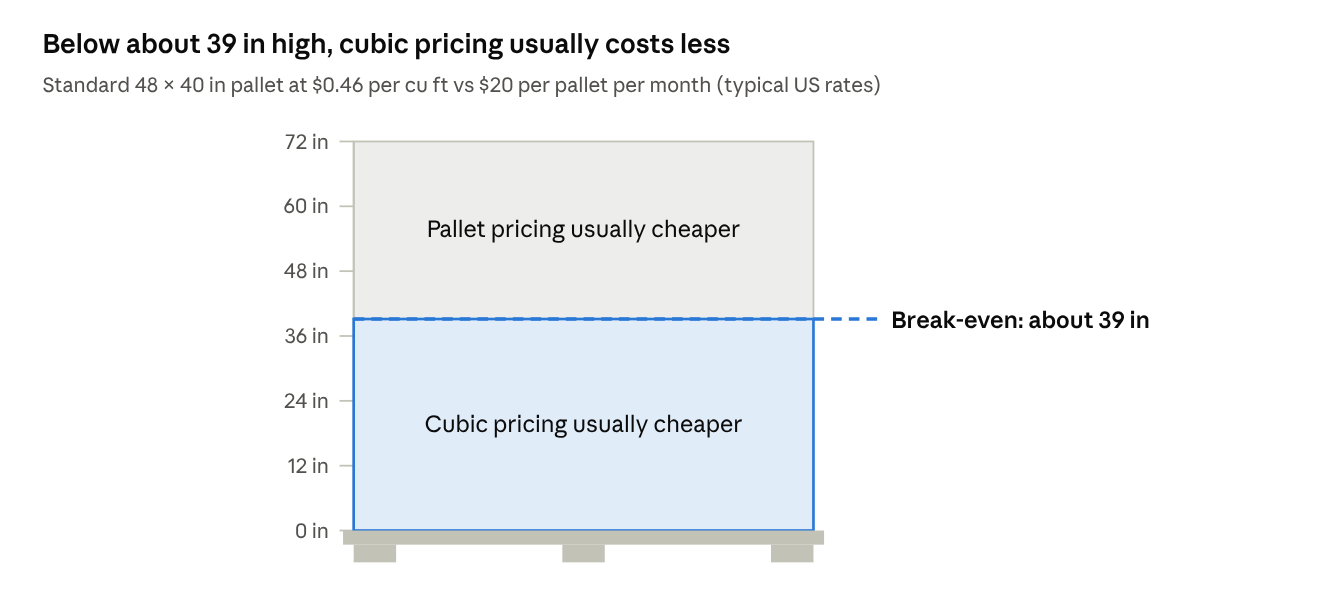
Break-even height on a standard pallet at typical US market rates
In the diagram, any load that stops below the dashed line is cheaper by the cubic foot; any load above it is cheaper by the pallet.
Measure your loads first with our Cubic Feet Calculator or Pallet Load Calculator.
Factors that decide which model suits your inventory
Four things about your inventory usually decide the answer. Check each one against your own stock.
Product size and shape
Small, light or irregular items rarely fill a pallet, so under pallet pricing you’d pay for empty space. Bulky goods and full cartons stack into full pallets, where a flat pallet rate is hard to beat.
Verdict: small items lean cubic; bulky goods lean pallet.
Inventory turnover
Fast-moving stock empties pallets quickly, so they sit half-full for much of the month, and cubic billing follows the drop. Slow-moving or bulk reserve stock sits on full pallets for months, where a flat pallet rate is easier to budget.
Verdict: fast movers lean cubic; slow, bulk stock leans pallet.
Number of SKUs
Many SKUs in small quantities each need their own pallet, which wastes space on every one. A few SKUs in bulk fill their pallets, so pallet pricing stays simple and cheap.
Verdict: many small SKUs lean cubic; a few bulk SKUs lean pallet.
How your goods arrive
Floor-loaded containers arrive as loose cartons that must be palletized or shelved, so ask how each model handles them and what container unloading costs. Palletized freight goes straight into pallet positions, or moves on quickly through cross docking.
Verdict: loose cartons lean cubic; palletized freight leans pallet.
Quick checklist
- Choose cubic if your pallets are usually under about 39 in high or half empty.
- Choose cubic if you store many SKUs in small quantities.
- Choose cubic if your stock sells quickly and volume drops through the month.
- Choose pallet if your goods arrive and stay on full, standard pallets.
- Choose pallet if you store a few SKUs in bulk for months at a time.
- Choose pallet if you want a fixed, predictable monthly bill.
Can you combine both pricing models?
Yes. Many warehouses offer hybrid billing, and for mixed inventory it’s often the cheapest option.
How it works. Full pallets of bulk stock are billed per pallet, while loose cartons and small SKUs are billed per cubic foot. Each part of your inventory goes on the model that suits it.
When it helps. Hybrid billing suits brands with a few bestsellers stored in bulk plus a long tail of small SKUs. It also helps when bulk stock arrives on full pallets but sells down into loose cartons over the season.
Example. At the same typical US rates:
- 10 full pallets of bestsellers × $20 = $200
- 150 cu ft of loose cartons × $0.46 = $69
- Total: $269 a month
If those loose cartons belong to different SKUs and each needed its own half-full pallet, 4 extra pallets would cost $80 instead of $69. Billing that part by the cubic foot is cheaper, and the gap grows as you add more small SKUs.
How to lower your storage costs
Whichever model you choose, these four habits keep the monthly bill down and make your quotes easier to compare.
Consolidate partial pallets. Combine half-empty pallets of the same SKU so you pay for fewer positions. Two pallets loaded to 30 in become one pallet at 60 in, which halves the pallet cost for that stock. Check for partial pallets every month, since they build up as stock sells.
Reduce empty space in cartons. Smaller, right-sized cartons mean fewer cubic feet under cubic pricing and more units per pallet under pallet pricing. Either way, you stop paying to store air. Start with the SKUs that take up the most space.
Track inventory in real time. Slow stock that sits for months quietly adds to every bill. Warehouse management systems show what’s moving and what isn’t, so you can clear slow SKUs before they cost months of storage. Set a review point, such as 90 days without a sale, to decide what to discount or remove.
Compare the total cost, not just the rate. Receiving, handling, minimum and long-term storage fees can outweigh a cheaper storage rate, and some warehouses raise rates in peak season. Ask for every line item and compare quotes on a full month of your real activity. Our pricing page lists each fee separately: receiving is free for most shipments, and storage has no monthly minimums, no long-term fees and the same rate year-round.
Need Help With Warehouse Storage?
ASTORAGEHUB provides cubic storage, pallet storage and fulfillment services for ecommerce and B2B businesses.
FAQ – Cubic feet vs pallet pricing
Pallet storage typically costs $12–$22 per pallet per month for dry storage in the US, with an average of around $20, according to market data. Temperature-controlled storage costs more, often $25–$50 or above. Your rate also depends on pallet height, location and the volume you store.
Cubic foot storage typically costs about $0.35–$0.60 per cubic foot per month in the US, with an average of around $0.46. At that average, 500 cubic feet of stored goods costs about $230 a month. The rate isn’t the whole cost, though: check how the warehouse measures your space, and whether it adds minimums, long-term or peak-season fees.
A standard 48 × 40 in pallet holds about 13.33 cubic feet for every foot of height. Loaded to 60 in high, that’s about 66.7 cubic feet; loaded to 48 in, about 53.3 cubic feet. Measure your real load height to get an accurate figure.
Often, yes, because small brands rarely fill full pallets. If your pallets are usually loaded below about 39 in high, cubic pricing will usually cost less at average US rates. Brands with a few bulk SKUs on full pallets may still save with pallet pricing.
Often, yes. Many 3PLs offer both cubic and pallet pricing, or a hybrid of the two, so ask when you request a quote. Switching usually makes sense when your inventory changes, for example when your average pallet height drops below about 39 in.
Conclusion
Neither model is always cheaper. Pallet pricing wins when your goods fill standard pallets and sit for a while; cubic feet pricing wins when you store small items, partial pallets or many SKUs. The quickest way to know is to run the break-even math with your own quotes: divide the pallet rate by the cubic rate and compare it with how full your pallets really are. If your inventory is a mix, a hybrid setup often costs the least.
Need Help With Warehouse Storage?
ASTORAGEHUB provides cubic storage, pallet storage and fulfillment services for ecommerce and B2B businesses.
About the Author
