

If you are an ecommerce seller, you should know that your shipping costs go up twice in the first four days of 2027: DHL Express raises prices on January 1, and FedEx follows on January 4. For ecommerce sellers, these are the first of several shipping rate increases and price changes landing in a single month.
There’s some good news too. USPS prices drop on January 18, when two temporary increases expire: the 8% transportation surcharge and the holiday prices. UPS, meanwhile, hasn’t published its 2027 prices yet.
Below you’ll find every date that matters, why the 5.9% headline understates what you’ll actually pay, and a simple October-to-February plan to keep your costs under control.
Key Takeaways
- DHL Express raises rates 5.9% on January 1, 2027.
- FedEx raises list rates 5.9% on average on January 4, with Ground closer to 6.1%.
- USPS’s 8% surcharge and holiday prices end January 17.
- UPS has not announced its 2027 increase yet.
Table of contents
- Why the 2027 rate increases matter for ecommerce sellers
- What changes for each carrier in 2027
- Where your real increase hides
- How much will your shipping cost in January 2027?
- How to reduce your 2027 shipping costs
- Should you switch carriers because of the 2027 increases?
- Questions to ask your 3PL before January
- FAQ – 2027 shipping rate increases
- Conclusion
Why the 2027 rate increases matter for ecommerce sellers
January feels far away, but the decisions that protect your margin happen now.
They come straight out of your margin. If you offer free or flat-rate shipping, your customers won’t pay more in January. You will, unless you adjust your prices or your shipping setup.
Four carriers, four different dates. DHL Express changes on January 1, FedEx on January 4, USPS on January 17–18, and UPS hasn’t set a date yet. Your cost per order can change more than once in a month, so one review in December isn’t enough. The table below lists every date.
The headline isn’t your number. The 5.9% figure is an average across all of a carrier’s services. What you pay depends on the services, weights, zones and surcharges you use, so a seller shipping light parcels by Ground can see a bigger jump.
If you ship from a 3PL, ask how these increases reach your invoice. A good ecommerce fulfillment partner should show you, line by line.
What changes for each carrier in 2027
~6.1% FedEx Ground increase · +9.1% extended delivery area surcharge · $12.70 FedEx Ground minimum
Sources: Logistics Management (Ground increase), AFMS (surcharge and minimum).
Here’s what each carrier is changing and when.
2027 rate changes by carrier
| Carrier | 2027 change | Effective date | What to watch |
|---|---|---|---|
| DHL Express | 5.9% general average (US accounts) | January 1, 2027 | Adjusted services and surcharges |
| FedEx | 5.9% average on list rates | January 4, 2027 | Minimums, DAS ZIP lists, Jan 18 fees, Feb 1 zones |
| USPS | 8% surcharge and holiday prices end | January 17, 2027 (midnight CT) | Possible replacement; no January 2027 filing yet |
| UPS | Not yet announced | TBD | Peak surcharges until January 16, 2027 |
FedEx: 5.9% from January 4
The FedEx 2027 GRI raises standard list rates by an average of 5.9% on January 4, 2027, according to FedEx. Behind this FedEx rate increase, four details matter more to ecommerce sellers than the headline.
- Ground rises more than 5.9%. The headline blends every service. According to Logistics Management, Express Saver rises about 3.1%, which pulls the average down, while Ground and Home Delivery rise about 6.06–6.15% depending on the zone. Most ecommerce sellers ship Ground, so your starting point is closer to 6.1%.
- Minimum charges go up. According to AFMS, the 1 lb Zone 2 Ground minimum rises from $11.99 to $12.70. Light parcels going a short distance often pay the minimum, so even a big discount may not help.
- Surcharges rise faster. AFMS reports the extended residential delivery area surcharge up 9.1%. Logistics Management puts Additional Handling up about 7.5%, to $31.75–$43.75 per package. FedEx also replaces its delivery area ZIP code lists on January 4, so some of your addresses may start paying that surcharge.
- Two later changes. From January 18, FedEx adds a $25 Paper Document Fee and a $5 Paper Air Waybill Fee, according to FedEx. You can avoid both by working electronically. On February 1, zones change for some ZIP code pairs.
DHL Express: 5.9% from January 1
The DHL Express rate increase is a general average of 5.9% for US account holders, starting January 1, 2027. DHL announced it on September 25, 2026, along with changes to “a limited number of services and surcharges.”
- Third year in a row. DHL also raised US prices 5.9% in 2025 and 2026, according to its announcements. Over three years, that adds up to about 19% (1.059 × 1.059 × 1.059 ≈ 1.188).
- Who it affects. Mainly sellers shipping internationally or cross-border. Ask your DHL account manager how the increase applies to your negotiated rates, and compare DHL with FedEx and UPS on your main international shipping lanes.
UPS: still pending
As of October 14, 2026, there’s no UPS rate increase for 2027 yet. The UPS daily rates page still shows the 2026 rate guide.
- What to expect. UPS matched the 5.9% headline in 2025 and 2026, and last year’s increase took effect December 22, 2025, according to eBB Logistics. This year’s could also land in December.
- What’s live now. UPS peak surcharges apply until January 16, 2027. According to Reveel, they run $0.50–$0.75 per package on Ground Residential and Ground Saver and $1.35–$2.50 on Air, depending on the week. Large packages pay more.
- How to budget. Until UPS announces, keep a 5.9–6.5% placeholder for UPS in your 2027 budget.
USPS: two temporary increases, then a price drop
The next USPS price change is a drop: from January 18, 2027, parcel prices fall when two temporary increases end.
- 8% transportation surcharge. Since April 26, 2026, USPS has added 8% to base prices for Priority Mail, Priority Mail Express, Ground Advantage and Parcel Select, according to USPS.
- Holiday prices on top. From October 4, 2026 to January 17, 2027, USPS also charges temporary holiday prices. According to USPS, commercial Ground Advantage labels carry an extra $0.40–$7.70, depending on weight and zone.
- January 18. Both increases end together, so parcels drop back to base prices. USPS hasn’t filed January 2027 prices yet and could replace the surcharge, so check again in December.
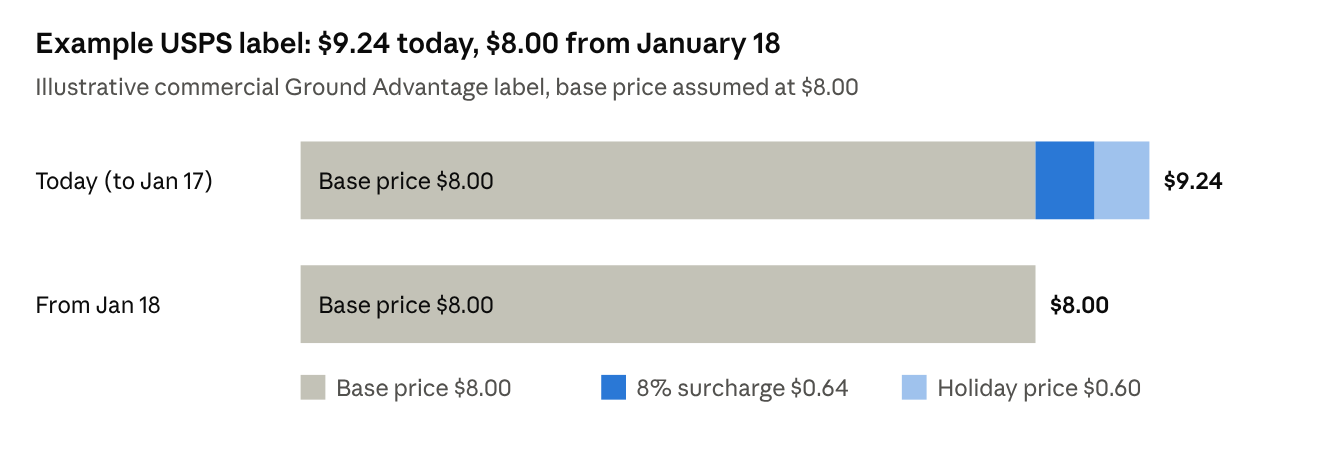
This matters most for Amazon FBM fulfillment, since FBM sellers ship a lot of Ground Advantage. On the example label above, about 13% of today’s price disappears on January 18.
Where your real increase hides
The 5.9% headline only covers base rates. Three other costs decide what you actually pay, and all three rise in 2027.
Minimum charges
What it is. Carriers set a minimum price per package. If you ship light parcels a short distance, you often pay that minimum, even when your contract gives you a big discount off list rates.
Why it matters in 2027. Minimums rise along with list rates. The FedEx Zone 2 Ground minimum goes from $11.99 to $12.70, according to AFMS. If you sell small, light products, you’ll feel this more than anyone.
Surcharges and accessorials
What they are. These are extra fees on top of the base price: residential delivery, delivery area surcharges, and Additional Handling for heavy, long or poorly packed boxes. Additional Handling often comes down to how an order is packed, which is why your pick and pack fulfillment setup affects your shipping bill.
Why they rise faster. Carriers set most of these fees separately from base rates, and they often go up by more. In 2027, FedEx’s extended delivery area surcharge rises 9.1%, according to AFMS, and Additional Handling about 7.5%, according to Logistics Management. Both are well above the 5.9% headline.
Dimensional weight
What it is. When a box is large but light, carriers charge for its size instead of its actual weight. For FedEx and UPS daily rates, the formula is:
Dimensional weight (lb) = Length × Width × Height (in inches) ÷ 139
The carrier then bills whichever is higher: the actual weight or the dimensional weight.
Why it matters. An oversized box already costs more to ship, and each yearly increase makes it cost more again. A 16 × 12 × 10 in box holding a 3 lb product is billed at 14 lb. Switching to right-sized cartons or branded packaging made to fit your product shrinks that gap before the new rates arrive.
How much will your shipping cost in January 2027?
For a typical mixed USPS and FedEx seller, the monthly bill goes up from January 4, then drops below December’s level from January 18.
Worked example
Assumptions (example figures, not real quotes): 1,000 parcels a month, 3 lb on average, 60% shipped with USPS Ground Advantage and 40% with FedEx Ground. The USPS base price is $8.00 per parcel and the FedEx Ground price is $11.00 per parcel in December. Fuel and other surcharges are left out to keep the math simple.
| December 2026 | January 4–17 | From January 18 | |
|---|---|---|---|
| USPS Ground Advantage (600 parcels) | $5,544 | $5,544 | $4,800 |
| FedEx Ground (400 parcels) | $4,400 | $4,668 | $4,668 |
| Monthly total | $9,944 | $10,212 | $9,468 |
| Change vs December | — | +$268 (+2.7%) | −$476 (−4.8%) |
How the numbers work: In December, a USPS parcel costs $8.00 + 8% surcharge ($0.64) + an example holiday amount of $0.60 = $9.24. From January 18, it drops back to the $8.00 base price. The FedEx Ground parcel rises 6.1% on January 4, from $11.00 to about $11.67. Monthly totals assume a full month at each period’s prices.
Want to run this with your own numbers? Try our calculators.
What this means for your pricing
Your shipping costs change twice in January, so review your free-shipping threshold and flat shipping rates after January 4 and again after January 18.
Live carrier rates at checkout update on their own. Flat rates and free-shipping thresholds don’t: they stay where you set them, even when your costs move. Free shipping weighs heavily on buying decisions, as covered in The Impact of Consumer Behavior Changes on E-Commerce, so adjust thresholds rather than dropping the offer.
How to reduce your 2027 shipping costs
You can’t stop the increases, but you can shrink how much of them you pay. Use this month-by-month checklist to stay ahead of each change.
Before January (October–December)
The work you do now decides how much of the increase reaches your margin, because contracts, packaging and software all take weeks to change.
- ☐ October: reprice your last 90 days of shipments on 2027 rates, and save a December baseline (cost per parcel by carrier, service and zone).
- ☐ November: right-size the top 10 SKUs that trigger dimensional weight or Additional Handling.
- ☐ November: set up rate shopping across carriers, and renegotiate minimums and discounts.
- ☐ December: check FedEx’s new delivery area ZIP lists against your top 50 destinations, switch paper documents to electronic, and watch for UPS and USPS announcements.
In January and February
Carrier prices change three times in about three weeks, so each change is a moment to recheck your prices.
- Three reviews: January 1 (DHL), the week of January 4 (FedEx) and the week of January 18 (USPS). After each, revisit your flat rates and free-shipping thresholds, and compare your cost per parcel with your December baseline.
- February: reprice your lanes after the February 1 FedEx zone changes.
Long-term levers
These take longer to set up, but they lower your costs every year, not just in January.
- Rate shopping: compare carriers on every label, not once a year. Store and carrier integrations make this automatic, so every order goes out with the cheapest carrier that meets your delivery promise.
- Shorter zones: shipping from a warehouse closer to your buyers can save more than any discount, because zone is one of the biggest drivers of parcel price. Read Lower Shipping Costs with a West Coast Hub and Faster Fulfillment Starts in California.
- Inbound and outbound efficiency: fewer, fuller shipments into the warehouse lower your total cost and free up budget for outbound increases. See Inbound and Outbound Shipping Efficiency.
Need Help With Shipping and Fulfillment?
ASTORAGEHUB provides warehousing and fulfillment services for ecommerce and B2B businesses, shipping with UPS, USPS and FedEx.
Should you switch carriers because of the 2027 increases?
Usually not. FedEx and DHL Express both raise rates 5.9% on average, so switching rarely escapes the increase. Comparing carriers on every shipment usually does more for you.
When switching makes sense. It’s worth moving volume if one carrier is consistently cheaper on your main weights and zones. The same goes if a carrier’s surcharges hit your products much harder than others do, for example Additional Handling on long or heavy boxes.
When rate shopping is better. Prices differ by package. One carrier may win on light parcels going nearby, another on heavier parcels going across the country. Comparing carriers on every label usually beats moving all your volume to one carrier and losing those wins.
The role of a 3PL. A 3PL ships for many brands, so it combines their volume. That can unlock rates a single brand can’t get alone. If you’re weighing a switch, ask an ecommerce fulfillment provider to compare your current costs with theirs, using your real shipment data.
Questions to ask your 3PL before January
If a 3PL handles your shipping, these five questions show how the 2027 increases will reach you, and what your partner is doing about them.
- What would my last three months of shipments cost at 2027 prices? That shows your real increase, based on your own services, weights and zones, not the 5.9% average.
- Is your pricing based on carrier discounts passed through at cost, or is there a markup? The answer decides whether the increase reaches you as is or grows on the way.
- Does your system pick the cheapest carrier for each order on its own? When staff choose carriers by hand, some orders ship at a higher price than they need to.
- Which of my products are billed by box size or charged extra handling fees? Repacking the worst offenders for dimensional weight and Additional Handling often saves more than a new discount.
- What’s your plan when UPS and USPS publish their 2027 prices? You want to know how fast rates get updated, and how quickly volume moves if a different carrier becomes cheaper.
Here’s how ASTORAGEHUB answers them. Billing is itemized, so you see exactly what each shipment costs. Our ASTORAGEHUB Platform gives you real-time visibility into inventory and orders. We ship with UPS, USPS and FedEx from our warehouse in Riverside, California, about 55 miles from the Ports of Los Angeles and Long Beach. See How We Work.
FAQ – 2027 shipping rate increases
DHL Express raises rates on January 1, 2027, and FedEx follows on January 4. FedEx then adds new paper document fees on January 18 and changes some zones on February 1. USPS prices drop on January 18, when its temporary increases end. UPS hasn't announced its 2027 date yet.
Yes. DHL Express raises prices by a general average of 5.9% for US account holders from January 1, 2027. It announced the change on September 25, 2026. This is the third 5.9% increase in a row, after the same rise in 2025 and 2026.
Not yet. As of October 14, 2026, UPS still shows its 2026 rate guide. Last year, it raised rates 5.9% from December 22, 2025, so a December 2026 announcement and start date are possible. Until then, budget 5.9–6.5% as a placeholder.
It's scheduled to end at midnight Central on January 17, 2027, along with the holiday prices. That makes USPS parcels cheaper from January 18. But USPS hasn't filed its January 2027 prices yet and could replace the surcharge, so check again in December.
Usually, yes. If your discount is a percentage off list prices, your rates rise along with the list. Check your agreement, especially minimum charges. The Zone 2 Ground minimum rises from $11.99 to $12.70, and discounts often can't take you below it.
Because 5.9% is an average across all services. Your real increase depends on your service mix, minimum charges, surcharges and dimensional weight. FedEx Ground rises about 6.1%, and some delivery area surcharges rise 9.1%, so Ground-heavy sellers often pay more than the headline.
Conclusion
January 2027 brings three carrier changes in less than three weeks, with UPS still to come, and the 5.9% headline hides a bigger increase for most ecommerce sellers. The sellers who come out fine are the ones who run their numbers now: they reprice recent shipments, fix their worst boxes, and set up rate shopping before the new prices land. Review your costs after each January change, keep UPS as a placeholder until it publishes, and you’ll know exactly what each order costs to ship.
Need Help With Shipping and Fulfillment?
ASTORAGEHUB provides warehousing and fulfillment services for ecommerce and B2B businesses, shipping with UPS, USPS and FedEx.
About the Author
