

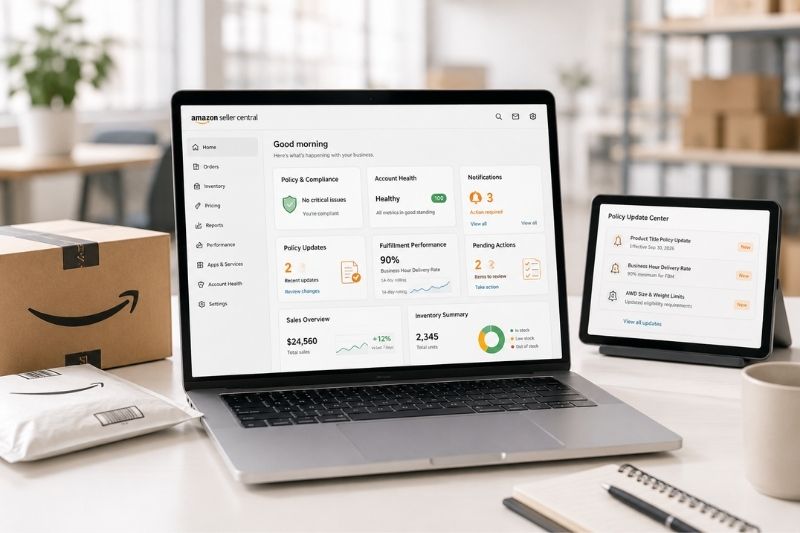
2026 is already bringing important changes for Amazon sellers. Product detail page rules have changed, new delivery-performance requirements are coming for certain Amazon Business FBM orders, Amazon Warehousing and Distribution has introduced new eligibility rules, and Seller Central itself is becoming more automated through AI-powered tools.
These updates can affect listings, fulfillment workflows, inventory planning, shipping performance, warehouse operations, and account health.For sellers, the important question is not only what changed, but also what needs to be updated operationally as a result.
Where to Find Official Amazon Seller Policy Updates
The best place to start is Amazon’s own seller resources. Third-party blogs, communities, and software platforms can be useful for commentary, but important requirements should always be verified through official Amazon documentation.
Seller Central Notifications
Seller Central notifications can include account-specific updates related to:
- compliance requirements
- listing restrictions
- fulfillment requirements
- shipping performance
- account health
- actions that require seller attention
Because some policy changes apply only to certain programs, categories, marketplaces, or seller accounts, these notifications are especially important.
Changes to Program Policies
Amazon maintains a dedicated Changes to Program Policies page where sellers can review recent and upcoming policy changes.
In 2026, Amazon has published updates affecting product detail page rules, seller-fulfilled Amazon Business delivery performance, handling-time requirements, services and warranties, and warehousing programs. For sellers using FBA, FBM, Amazon Business, or Amazon warehousing programs, this should be one of the primary pages to monitor.
Account Health
The Account Health dashboard remains essential for seller-performance and compliance monitoring. Amazon uses it to surface metrics that can affect program eligibility and seller-fulfilled offers. For example, eligible sellers can review their Business Hour Delivery Rate through Account Health.
Seller Forums and Amazon Announcements
Amazon Seller Forums can also provide useful context when new requirements are introduced. The News and Announcements section includes direct communication from Amazon, while seller discussions can help identify how policy changes are affecting real operations. Community discussion can be useful, but Amazon’s own documentation should remain the final reference point for compliance decisions.
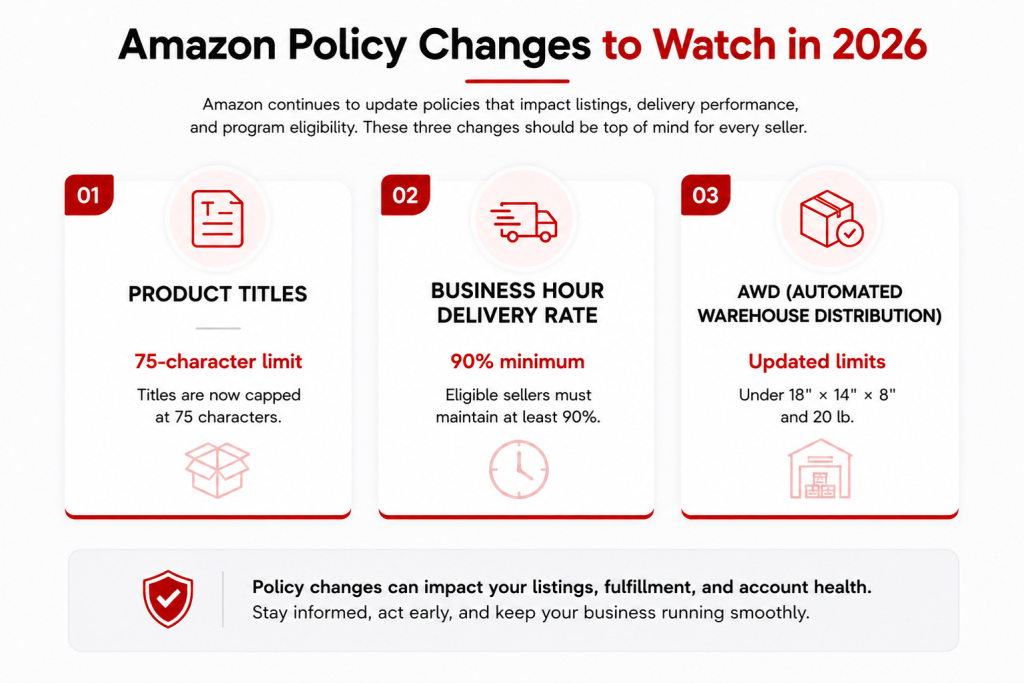
Amazon Policy Changes Sellers Should Watch in 2026
In 2026, Amazon has introduced changes that directly affect how sellers manage listings, FBM deliveries, inventory routing, and warehouse operations.
Product Titles Are Now Limited to 75 Characters
The most important Amazon policy updates in 2026 affect product listings, FBM delivery performance, warehousing eligibility, and seller operations. Amazon also introduced a new Item highlights attribute with a limit of 125 characters. Sellers therefore have up to 200 characters across the two fields to communicate key product information.
For sellers with large catalogs, this may require more than simply rewriting titles.
Teams may need to:
- review existing product titles
- update listing templates
- revise product feeds
- check marketplace integrations
- move important information into the Item highlights field
If product data is sent to Amazon through an API, ERP, PIM, feed manager, or marketplace integration, those systems should also be reviewed.
New Business Hour Delivery Rate Requirements for FBM
Starting September 30, 2026, Amazon will require applicable sellers to maintain a Business Hour Delivery Rate of at least 90% for seller-fulfilled Amazon Business orders delivered to commercial addresses. The metric measures whether eligible shipments are delivered on the first attempt and during the customer’s business hours.
Amazon calculates the metric over a rolling 14-day period. If the rate remains below 90%, Amazon may eventually deactivate affected FBM offers for Amazon Business customers. FBA offers are not affected.
For FBM sellers, this puts more attention on operational execution.
Sellers should review:
- handling times
- warehouse cut-off times
- carrier performance
- shipping methods
- commercial-address delivery patterns
- shipping settings
This is a good example of how an Amazon policy update can quickly become a warehouse and carrier-management issue.
Amazon Warehousing and Distribution Eligibility Has Changed
Amazon is also adjusting its Warehousing and Distribution program.
Starting July 31, 2026, Amazon Warehousing and Distribution will accept only sortable products that are smaller than 18″ × 14″ × 8″ and weigh less than 20 lb. Larger or heavier products must be sent directly to Amazon’s fulfillment network through Send to Amazon.
For sellers using AWD as part of their inventory strategy, this can affect:
- where inventory is stored
- which products are eligible for upstream storage
- replenishment planning
- inbound shipment routing
- allocation between Amazon and third-party warehouses
This makes accurate inventory visibility increasingly important, especially for sellers using a combination of FBA, FBM, Amazon warehousing, and external 3PL storage.
Seller Central Is Becoming More AI-Driven
Amazon is also changing the Seller Central experience itself. In March 2026, Amazon introduced its new Canvas Experience for sellers in the U.S. The system combines AI-powered chat with seller data, visual analysis, and recommended actions inside Seller Central. Sellers can explore performance trends, inventory, stockout risk, storage fees, revenue, and other operational data.
Amazon is gradually moving Seller Central from a platform that primarily displays information toward one that also interprets business data and recommends next steps. For sellers, this increases the value of accurate and consistent inventory, fulfillment, and operational data.
Why Amazon Policy Changes Affect Warehouse Operations
Amazon policy changes often begin inside Seller Central, but their impact can extend directly into physical operations.
A listing update may require changes to product data. A new delivery metric can affect warehouse cut-off times and carrier selection. A change to warehousing eligibility can alter inventory-routing decisions. An FBA requirement can affect preparation, labeling, or inbound shipments. That means policy monitoring should not sit only with a marketplace manager.
Depending on the update, teams may need to coordinate across:
- inventory management
- FBA preparation
- FBM fulfillment
- warehouse operations
- carrier management
- product data
- internal SOPs
- system integrations
What Sellers Should Do After an Amazon Policy Update
A repeatable process makes policy changes easier to manage.
1. Verify the Official Requirement
Check Amazon’s original documentation and confirm:
- effective date
- applicable marketplace
- affected program
- seller type
- product categories
- performance threshold
2. Identify Affected Products and Workflows
Determine whether the change affects:
- ASINs
- product listings
- FBA inventory
- FBM orders
- packaging
- labeling
- inbound shipments
- shipping settings
- account-health metrics
3. Update Internal Procedures
If the change affects fulfillment, update warehouse or operations SOPs before the effective date. Teams should know exactly which products, orders, or processes require a different workflow.
4. Review Integrations and Automations
If Amazon data flows into a CRM, ERP, OMS, WMS, or 3PL platform, confirm that existing integrations still support the required workflow. Changes to product fields, shipping requirements, or fulfillment procedures may require updates to data mapping, automations, or order rules.
5. Monitor Results
After implementation, review:
- order status
- inventory accuracy
- delivery performance
- shipment exceptions
- listing errors
- account health
This helps identify operational issues before they affect a larger portion of the business.
Why Connected Amazon and Warehouse Data Matters
For growing Amazon sellers, the marketplace and the warehouse should not operate as separate systems. Orders, inventory, shipment status, product information, and fulfillment instructions all need to move between teams and platforms. When those processes rely heavily on manual entry, policy changes become harder to implement consistently.
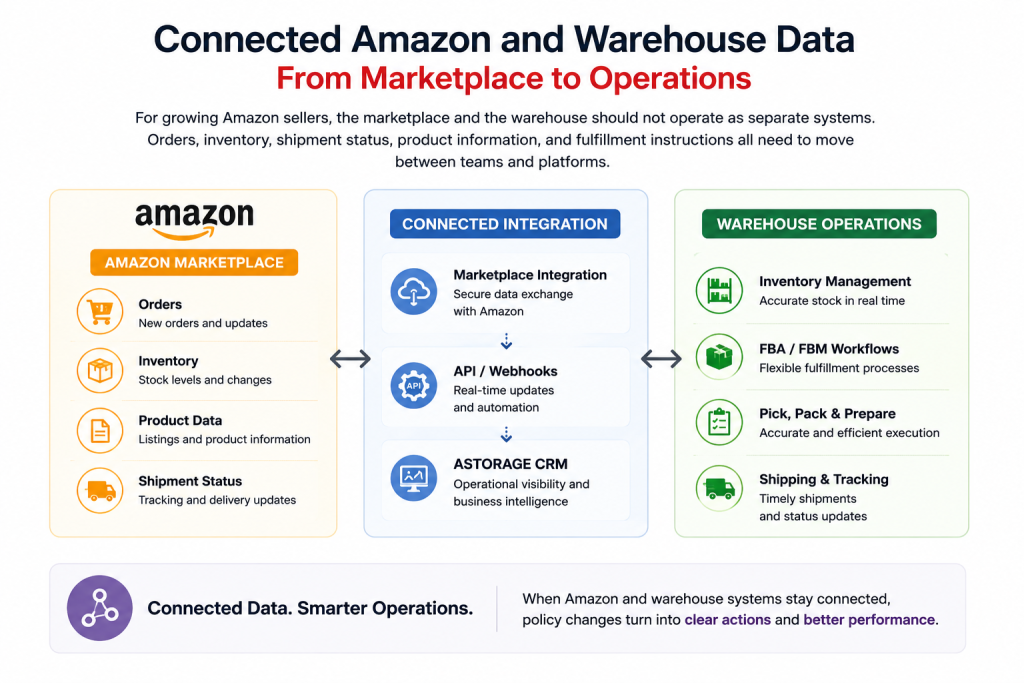
Amazon and Warehouse Integration
ASTORAGE supports Amazon FBA and FBM workflows through marketplace and warehouse integrations that connect Amazon activity with fulfillment operations.
Depending on the workflow, integration can help with:
- automated order creation
- inventory synchronization
- shipment-status updates
- FBA and FBM workflow management
- product-data exchange
- reduced manual data entry
Internal link: Amazon / Marketplace Integrations
ASTORAGE CRM
The ASTORAGE CRM provides operational visibility into products, inventory, inbound shipments, orders, fulfillment activity, documents, reporting, and billing. For Amazon sellers, this means marketplace changes can be evaluated against actual operational data. If a policy affects a specific group of orders, products, or shipments, teams can identify those workflows more easily instead of relying only on marketplace notifications.
API and Webhook Connectivity
For companies using ERP, OMS, ecommerce platforms, or custom software, API connectivity provides another layer of automation.
ASTORAGE API capabilities can support workflows such as:
- automated order submission
- inventory synchronization
- shipment updates
- product management
- reporting
- webhook notifications
This can be especially useful for brands operating across Amazon, Shopify, WooCommerce, and other sales channels.
Technology Does Not Replace Policy Monitoring
Technology can help execute operational changes, but it does not replace Amazon’s policies or Seller Central. Sellers still need to determine what a policy requires and whether it applies to their business. The value of integration comes afterward. Once a requirement is understood, connected systems can help apply the change more consistently across inventory, orders, fulfillment, and warehouse operations.
FBA and FBM Sellers May Need Different Responses
Amazon policy changes do not always affect FBA and FBM sellers in the same way.
With FBA, Amazon manages most outbound fulfillment, while sellers remain responsible for areas such as:
- inventory planning
- product preparation
- inbound shipments
- labeling
- compliance
- account management
With FBM, sellers control a much larger part of the fulfillment process.
That includes:
- handling times
- pick and pack
- shipping methods
- carrier selection
- tracking
- delivery performance
- customer delivery expectations
The Business Hour Delivery Rate requirement illustrates this difference clearly: it applies to qualifying seller-fulfilled Amazon Business shipments, while FBA offers are not affected. For FBM sellers, warehouse and carrier performance can therefore have a direct impact on marketplace eligibility.
Build a Simple Amazon Policy Monitoring Routine
Sellers do not need to check every Amazon page every day. A simple recurring process is usually sufficient.
A practical routine can include:
- checking Seller Central notifications
- reviewing Account Health
- monitoring Changes to Program Policies
- documenting major updates and effective dates
- identifying affected SKUs
- updating warehouse SOPs when necessary
- reviewing system integrations
- monitoring performance after implementation
The objective is to turn policy monitoring into a normal operational process rather than reacting only when a problem appears.
Amazon Seller Policy Update FAQ
Where can I find Amazon Seller Central policy updates?
Amazon publishes updates through Seller Central notifications, Changes to Program Policies, Account Health, program-specific help pages, official announcements, and Seller Forums.
How often does Amazon change seller policies?
There is no fixed schedule. Changes can be introduced throughout the year across listings, fulfillment, seller performance, fees, inventory programs, and marketplace requirements.
Do Amazon policy updates affect both FBA and FBM sellers?
Not necessarily. Some changes affect all sellers, while others apply only to FBA, FBM, Amazon Business, certain product categories, or specific marketplaces.
What is the Business Hour Delivery Rate?
Business Hour Delivery Rate measures the percentage of qualifying Amazon Business FBM shipments delivered on the first attempt and during the customer’s operating hours.
Starting September 30, 2026, affected sellers must maintain a rate of at least 90%.
What should sellers do when Amazon announces a new policy?
Start by reviewing the official Amazon documentation. Then identify affected products and workflows, update internal procedures, review integrations, communicate changes to operations teams, and monitor performance after implementation.
Can warehouse integrations help with Amazon policy changes?
They can help operationally. Integrations can keep order, inventory, shipment, and warehouse data synchronized after a seller determines what the new policy requires. They do not replace Amazon compliance monitoring.
Keep Amazon Operations Ready for Change
Amazon Seller Central policy updates are a normal part of operating on the marketplace.
The most effective approach is not simply to follow Amazon news. Sellers need to understand how a change affects listings, inventory, fulfillment, shipping, and warehouse execution. For businesses managing Amazon FBA, FBM, or multiple ecommerce channels, connected operational systems can make those changes easier to implement consistently.
ASTORAGE combines Amazon fulfillment services with CRM visibility, marketplace integrations, and API connectivity to help ecommerce brands connect marketplace activity with warehouse operations.