

You’ve signed with a 3PL. Next week your first container arrives at their dock. What actually happens between that dock and your customer’s door?
That journey is 3PL fulfillment: an outside provider stores your inventory and handles every order for you.
This guide walks you through the full 3PL fulfillment process in ten steps, with a diagram you can follow from the first container to the delivered order. You’ll also see what a 3PL fulfillment center includes, how 3PL shipping works and which KPIs to expect from your provider. It covers both ecommerce and B2B orders, because many brands ship parcels to shoppers and pallets to retailers from the same stock.
Quick answer: 3PL fulfillment means a third-party logistics provider stores your inventory and handles your orders for you: it receives your stock, stores it, picks and packs each order, ships it with the best carrier and processes returns, while your store or ERP sends orders automatically.
Table of contents
What is 3PL fulfillment?
3PL fulfillment is outsourced order fulfillment. A third-party logistics provider receives, stores, picks, packs and ships your products from its own warehouse, and handles your returns.
Most 3PL fulfillment services cover receiving, storage, pick and pack, shipping and returns. Many also offer value-added work: kitting (bundling items into sets), prep for Fulfillment by Amazon (FBA), labeling and retail compliance, which means meeting a retailer’s rules for labels, packaging and paperwork.
The big difference between third-party logistics fulfillment and doing it in-house is how you pay. Instead of leasing a warehouse, hiring staff and buying systems, you pay for the space and work you actually use.
A 3PL is the operator: it does the physical work while you set the rules. For how that differs from a provider that manages your whole supply chain, see 3PL vs 4PL.
The 3PL fulfillment process, step by step
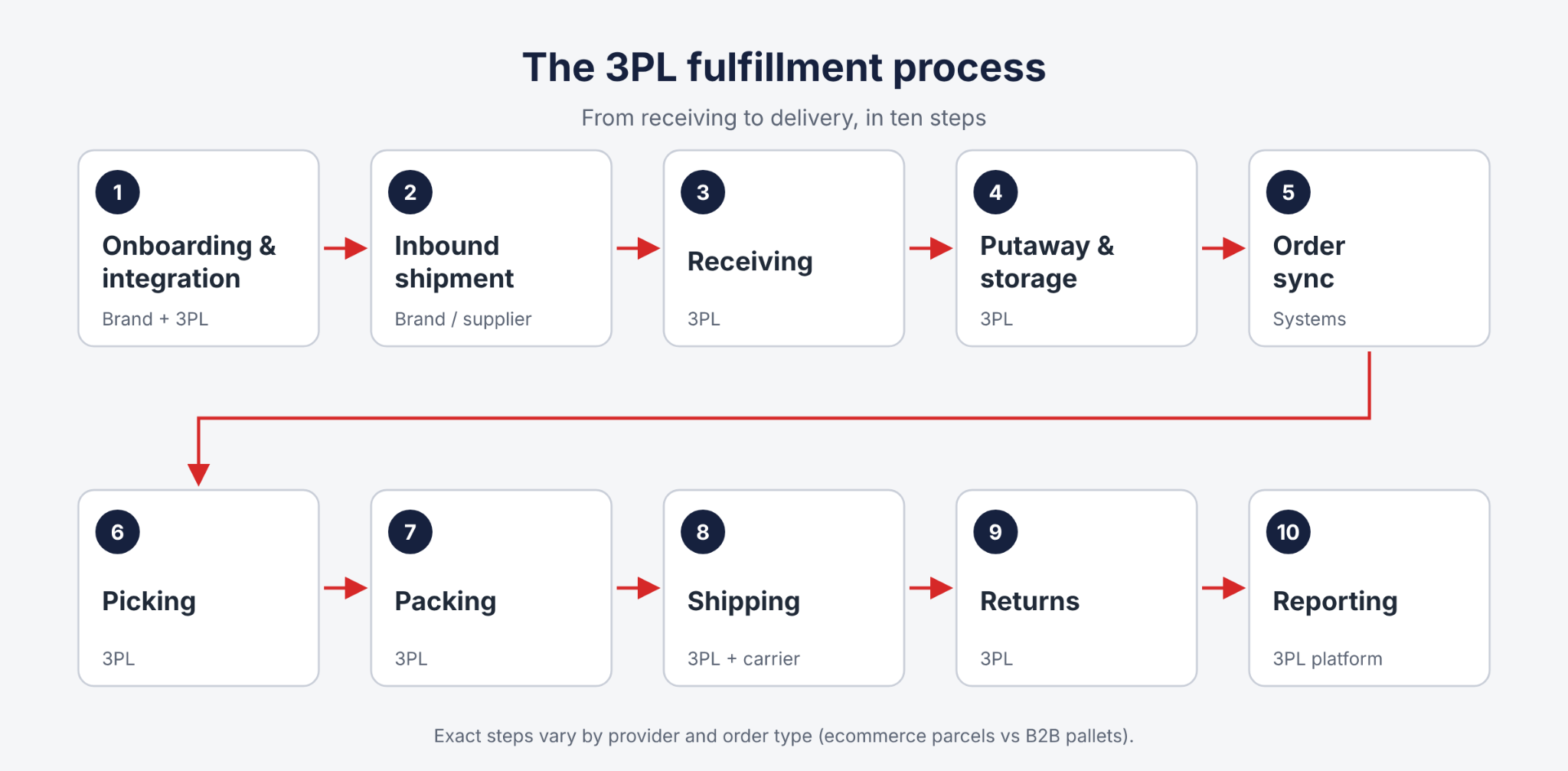
Every provider works a little differently, and the exact steps vary by order type (ecommerce parcels vs B2B pallets). But the 3PL process flow almost always follows these ten steps.
1. Onboarding and integration
First, the 3PL connects your online store, marketplaces or ERP (your business management software) to its systems. Together you set up each SKU (stock-keeping unit) with its barcode, plus packaging rules and shipping rules: which box, which carrier, which service level. Onboarding typically takes weeks, not months.
2. Sending inventory (inbound)
Before stock arrives, you or your supplier send an advance shipping notice (ASN) or packing list, label each carton and book a delivery appointment. Freight arrives either palletized, ready for a forklift, or floor-loaded, with loose cartons unloaded by hand, as is common for containers coming through the Ports of Los Angeles and Long Beach.
3. Receiving
At the dock, the 3PL unloads the shipment, counts it against the ASN, inspects it for damage and labels anything that needs it. Preparation drives receiving costs: shipments with accurate paperwork and labeled cartons are received faster and cost less.
4. Putaway and storage
Next, stock moves to its storage location: a pallet position, shelf or bin. Fast-moving products go near the pick area to cut walking time. Your inventory becomes sellable once it’s scanned into its location and shows as available in the system.
5. Order sync
When a customer buys, the order flows in automatically from Shopify, Amazon, Walmart, TikTok Shop or, for retail orders, EDI (electronic data interchange). Through these integrations [LINK: integrations page], stock levels update across all your sales channels, so you don’t sell what you no longer have.
6. Picking
The warehouse system sends pickers on a set route through the aisles. At each location, the picker scans the item’s barcode, and the system flags a wrong product or quantity before it leaves the shelf. Accurate pick and pack [LINK: pick and pack page] depends on that scan.
7. Packing
Packers choose a right-sized box or mailer, add any inserts or branded packaging, and include a packing slip. A weight check confirms nothing is missing. Box size matters more than it seems: carriers often bill by dimensional weight [LINK: dimensional weight article, if live], so packing choices change your shipping cost.
8. Shipping
The system picks the carrier and service for each order, and the label prints. Packages go to the carrier before the daily cutoff, and tracking goes to your customer. B2B orders ship by pallet as LTL (less-than-truckload) or FTL (full truckload) freight, often following retailer routing rules.
9. Returns
When a customer sends an item back, the 3PL receives it, inspects it and either restocks it or sets it aside. Your store updates so the item can be sold again. A clear returns [LINK: returns page] process keeps refunds and restocking moving.
10. Reporting and billing
Throughout, you see your stock, orders and charges in real time in the 3PL’s platform. There’s no waiting for a monthly report to know what’s on the shelf. You can check what sold, what shipped and what each service cost.
Need Help With Fulfillment?
ASTORAGEHUB provides warehousing, fulfillment and distribution for ecommerce, wholesale and B2B businesses near the Ports of Los Angeles and Long Beach.
What a 3PL fulfillment center includes
A 3PL fulfillment center is a warehouse where a third-party logistics provider stores client inventory and packs and ships orders. Most centers offer a core set of standard services and bill extra work separately.
Standard services
- Receiving
- Storage, billed by pallet, shelf, bin or cubic foot
- Pick and pack
- Packing materials
- Shipping
- Returns
Common add-ons, usually billed separately
- Kitting [LINK: kitting guide] and bundling
- FBA prep and labeling
- Branded packaging and inserts
- Container unloading
- Transloading (moving goods from one container or trailer to another) and cross-docking (moving goods from inbound to outbound with little or no storage)
- Retailer compliance labeling
Before you sign, ask which services are included in the base rates and which are billed per activity. Two providers with similar storage rates can cost very different amounts once add-ons are counted. Our guide to how 3PL pricing works explains the common fee types.
Fulfillment center vs distribution center: a fulfillment center ships individual orders, often to consumers, while a 3PL distribution center moves larger volumes, often by pallet, to stores or other warehouses. Many 3PLs run both from the same building (see fulfillment center vs distribution center [LINK: comparison article, add once live on December 9]).
How 3PL shipping works
3PL shipping comes down to a handful of levers that decide how fast your orders arrive and what each one costs.
- Carrier mix: 3PL carriers usually include UPS, FedEx, USPS, regional parcel carriers and LTL freight carriers. The 3PL picks the carrier and service for each order based on destination, delivery speed and cost.
- Shipping rates: because 3PLs ship in volume, many have negotiated rates with their carriers. Ask whether shipping is billed to you at cost or with a markup.
- Zones and location: carriers price parcels by zone, which reflects distance. The closer the warehouse is to your customers or stores, the lower the zone and the faster the delivery. A warehouse in Southern California, for example, reaches West Coast customers and stores in fewer zones than one farther east.
- Box size and billable weight: carriers bill the higher of a package’s actual weight and its dimensional weight (length × width × height ÷ a divisor). In 2026, UPS (Daily Rates), FedEx and USPS (for parcels over 1 cubic foot, since July 12, 2026) all use the same 139 divisor. Read more about dimensional weight [LINK: dimensional weight article, if live].
- Cutoff times: orders that reach the 3PL before its daily cutoff ship the same day, so ask each provider what its cutoff is.
- B2B shipments: pallet orders ship LTL or FTL, often following the retailer’s routing guide, which sets rules for carriers, appointments and paperwork.
- Rates change every year: UPS raises rates by an average net 5.9% from December 21, 2026, and FedEx by an average 5.9% from January 4, 2027. Those are averages, and individual surcharges can rise more. See our breakdown of the 2027 carrier rate increases [LINK: October rate increases article].
The technology behind 3PL fulfillment
Behind every step of 3PL order fulfillment sits a set of systems that keeps your stock and orders in sync.
- WMS: the warehouse management system tracks every location and unit, directs picking and putaway, and runs the scan checks. It’s the record of where every unit sits.
- Integrations: integrations [LINK: integrations page] connect the WMS to Shopify, Amazon, Walmart, TikTok Shop, ShipStation and ERPs, so orders and stock sync automatically, with no re-keying orders or updating stock by hand. Retail orders often arrive by EDI.
- Client portal: a dashboard where you see real-time inventory, order status and billing. ASTORAGEHUB clients get this view through the ASTORAGEHUB PLATFORM.
- Scanning and verification: barcode scans at receiving, picking and packing catch mistakes before an order leaves the building. These checks are what keep accuracy high.
You don’t need to run any of this yourself. You just need to know your 3PL has it, and that it connects to the channels you sell on.
Fulfillment for ecommerce and B2B orders
A 3PL handles two very different kinds of orders, often from the same warehouse. Ecommerce orders are built around speed and presentation; B2B orders are built around the retailer’s rules.
| Ecommerce orders | B2B and wholesale orders | |
|---|---|---|
| Order size | Single units and small orders | Cases and pallets |
| Ships to | Consumers | Retailers and distributors |
| Carriers | Parcel carriers | LTL and FTL freight |
| Timing | Fast daily cutoffs | Scheduled delivery appointments |
| Requirements | Branded unboxing and inserts | Routing guides, labeling and EDI |
| Packaging | Mailers and right-sized boxes | Labeled cartons on wrapped pallets |
Many brands sell both ways. When one 3PL fulfillment solution handles both from one stock pool, you avoid splitting inventory between a parcel warehouse and a wholesale warehouse, and one count covers every channel. Getting B2B details right matters too: retailers often charge fees, called chargebacks, when a shipment misses their labeling or delivery rules. Learn more about ecommerce fulfillment and B2B fulfillment [LINK: B2B fulfillment page].
KPIs to expect from a 3PL
A good 3PL measures its own performance and shares the numbers with you. These five KPIs show whether your orders are in safe hands.
- Order accuracy: the share of orders shipped with no errors. Formula: error-free orders ÷ total orders × 100.
- On-time shipping: the share of orders shipped by the cutoff or promised date. Formula: orders shipped on time ÷ total orders × 100.
- Dock-to-stock time: how long it takes from a delivery arriving at the dock to the stock being available to sell. Formula: time stock becomes available − time the delivery arrives.
- Inventory accuracy: how closely the system count matches the physical count. Formula: items whose system and physical counts match ÷ items counted × 100.
- Capacity use and backorders: how full the storage is, and how many order lines can’t be filled from stock. Formulas: space used ÷ total space × 100; backordered lines ÷ total order lines × 100.
These aren’t arbitrary. WERC’s 2026 DC Measures Report, released in September 2026, lists on-time shipping, dock-to-stock time, capacity use and backorders among the metrics distribution centers use most.
When you compare providers, ask for these KPIs in the service-level agreement (SLA), along with how often they’re reported. For more on vetting providers, see how to choose a 3PL provider.
FAQ – 3PL fulfillment
3PL fulfillment is outsourced order fulfillment: a third-party logistics provider stores your inventory and receives, picks, packs, ships and returns orders for you. Your store or ERP sends orders to the 3PL automatically, so you never touch a box, and you can follow stock and orders in the 3PL’s platform.
3PL fulfillment services include receiving, storage, pick and pack, shipping and returns, with add-ons such as kitting, FBA prep and container unloading. Add-ons are usually billed separately, so ask each provider which services sit in its base rates and which it charges per activity.
The 3PL picks the carrier and service for each order, often at negotiated rates, prints the label and hands the package to the carrier before the daily cutoff. The choice depends on destination, speed and cost, and your customer gets tracking as soon as the package is on its way.
A 3PL fulfillment center is a warehouse run by a third-party logistics provider where client inventory is stored and orders are packed and shipped. One center usually serves many brands at once, with each client’s stock tracked separately by location in the warehouse management system.
A fulfillment center ships individual orders, often to consumers, while a distribution center moves larger volumes, often by pallet, to stores or other warehouses. Many 3PLs run both from the same building, so one stock pool can serve online and wholesale customers.
Usually a few weeks, covering integrations, SKU setup and the first inbound shipment. The timeline depends mostly on how ready your product data is: clean SKUs, barcodes and packaging rules make onboarding faster, as does booking your first delivery early.
Send an advance shipping notice (ASN) or packing list, label each carton, and book a delivery appointment. Your 3PL shares its receiving requirements before your first shipment, and following them closely means your stock is counted, checked and ready to sell sooner.
Conclusion
3PL fulfillment turns a long list of daily jobs into one process someone else runs: receiving your stock, storing it, packing every order, choosing the carrier and handling returns. Your part is the setup: clean product data, labeled inbound shipments and clear rules for packaging and shipping. When those are in place, orders flow from your store to your customer without you touching a box, and you can see every unit and every order in real time.
Need Help With Fulfillment?
ASTORAGEHUB provides warehousing, fulfillment and distribution for ecommerce, wholesale and B2B businesses near the Ports of Los Angeles and Long Beach.
About the Author
